KEY HIGHLIGHTS
- Budget 2026 may scale back CDC vouchers as inflation pressures ease
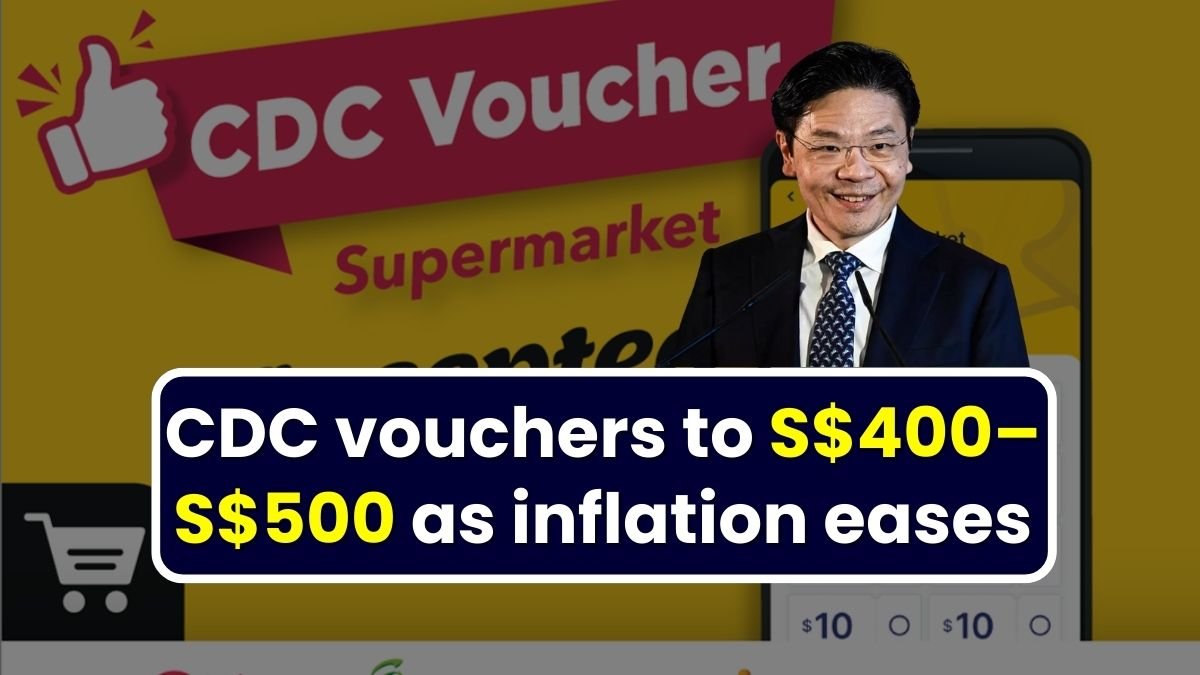
- Economists expect smaller payouts of S$400–S$500, down from S$800 in 2025
- Lower-income households likely to remain prioritised under tighter targeting
With inflation easing, economists expect Singapore’s CDC voucher scheme to continue in Budget 2026, but in a reduced and more targeted form rather than broad-based payouts.
CDC Vouchers Budget 2026
| Item | Latest Estimate |
|---|---|
| Core inflation (2025) | 0.7% |
| Peak inflation (2022) | 6.1% |
| CDC vouchers (2025) | S$800 per household |
| Expected CDC vouchers (2026) | S$400–S$500 |
Why CDC Vouchers May Be Reduced
Economists note that the sharp inflation spike that justified broad handouts during the pandemic years has passed. With prices stabilising, there is less need for universal cash-equivalent support.
Instead, policymakers are expected to refine eligibility, ensuring relief reaches households that still feel cost pressures, while avoiding expectations that vouchers are automatic every year.
What Economists Are Saying
Most analysts do not expect the CDC voucher scheme to be removed abruptly. Cost-of-living concerns remain politically and socially important, making a complete withdrawal unlikely.
However, several economists anticipate:
- Lower payouts, reflecting a more stable inflation environment
- Tighter income targeting, with higher-income households receiving less
- Tiered support, rather than a flat amount for all households
This would mark a shift away from broad schemes such as the SG60 vouchers, which were designed for exceptional circumstances.

Will Other Voucher Schemes Continue?
Views are mixed on whether ad hoc schemes will be extended in Budget 2026.
More likely to continue
- Climate Vouchers, which support decarbonisation goals
- U-Save and service & conservancy charges rebates, which offset essential household costs
Less likely to be repeated
- SG Culture Pass, which is widely seen as a one-off SG60 initiative with a long expiry ending in December 2028
Future extensions may depend on take-up rates and whether schemes meet specific policy outcomes.
Supportive Budget, But With Discipline
Despite expectations of reduced broad-based handouts, Budget 2026 is still expected to be supportive overall. Government revenues remain strong, with operating revenue reaching S$98.5 billion in the first nine months of FY2025, or 80.2% of the full-year forecast.
Economists expect spending priorities to shift towards:

- An ageing population
- Climate resilience
- Artificial intelligence adoption
- Medium-term economic and defence resilience
Targeted help for groups such as low-wage workers, seniors, young parents, and displaced workers is likely to remain part of the policy mix.
Why This Matters
For households, smaller CDC vouchers mean planning ahead for tighter support rather than assuming annual payouts. For the government, scaling back universal schemes helps preserve fiscal space for longer-term challenges while still addressing immediate needs.
The key signal from economists is not withdrawal, but calibration — moving from emergency-style relief to more precise, needs-based support.
[Link to Official Source – Apply Here]
FAQs
Will CDC vouchers end in 2026?
A complete end is unlikely. Economists expect continuation with smaller amounts and tighter targeting.
How much might households receive?
Estimates range between S$400 and S$500, compared with S$800 in 2025.

Who is likely to benefit most?
Lower-income households are expected to remain the main beneficiaries under a tiered system.
For more of BT’s Budget 2026 coverage, go to bt.sg/budget26